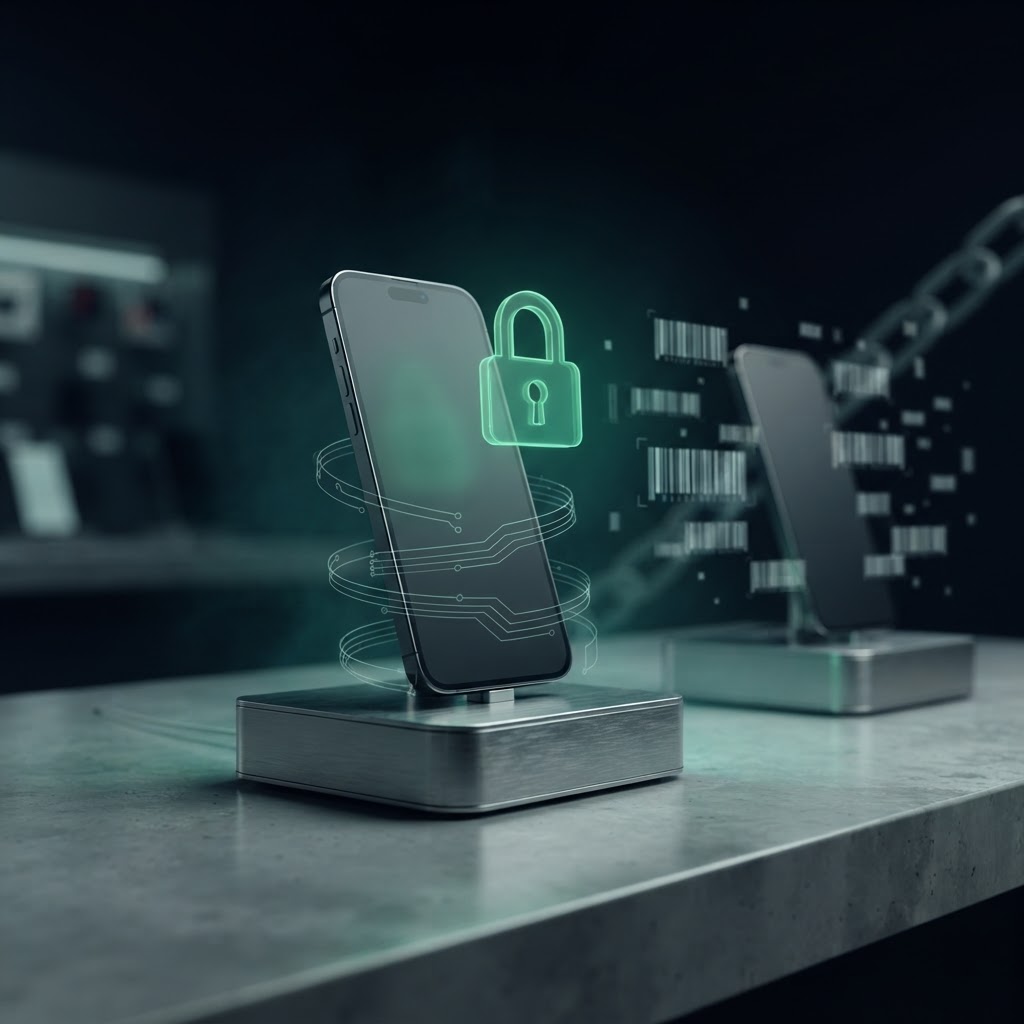
Should Big Tech Adopt BricTECH to Shut Down the Stolen-Phone Black Market?
Financed phones that never get paid for and demo units that walk out the door both end up on the black market — which is exactly what BricTECH, Sennco's software tether, is built to stop. Here is how the lock actually works, why it could cut device theft and make no-money-down financing viable, and the five rules big tech needs to adopt before putting a kill switch in a billion pockets.
A flagship phone leaves the store for $0 down. Eighteen months later the buyer stops paying, lists it on a marketplace, and a stranger two states away activates it on a new carrier. The carrier eats the loss. The marketplace never knew. And the next buyer is holding a device with a lien nobody can see.
That is the exact loophole BricTECH is built to close — and it is why the question is no longer whether software should ride along with a financed device, but whether the biggest companies in tech should make that lock standard equipment.
The Two Losses Nobody Wants to Name
Device fraud shows up on a carrier's books in two very different shapes:
- Theft with velocity. A demo unit is cut from its cable, or a shipment disappears between the depot and the store, and the hardware is on a marketplace within hours.
- The slow bleed. A customer signs a 24-month agreement, pays nine months, then stops — and sells a phone they do not legally own.
Both end in the same place: a working handset in the secondary market that nobody in the chain approved. Both share one root cause — a phone that still works is a phone that still sells.
What BricTECH Actually Is
BricTECH is not one product. It is a suite from Sennco, a retail security company that spent years building steel cable tethers for display phones and has since replaced them with software:
| Product | What it does |
|---|---|
| Device Management | Locks, tracks, and remotely manages company-owned Android and Windows devices with configurable security profiles |
| Device Finance | Runs lease and rental programs, sends payment reminders, and locks the device until the bill is paid |
| Live Display | Turns a store demo phone into a fully usable handset that locks itself the moment it leaves the store |
| Liquid Signage | Replaces paper price tags with live digital pricing — the least controversial piece in the box |
The mechanism is a digital tether. On a display unit it behaves like the old steel cable, minus the cable: the customer can pick the phone up, hold it, walk the store with it, and the instant it crosses a boundary the software locks it, sounds an alarm, or both.
For financed devices, the same lock persists after the sale. Sennco partners with Trustonic, whose locking technology sits in the chipset's trusted execution environment — below Android, below the app layer — which is why it can plausibly survive a factory reset or a reflash. That is the part that collapses a thief's business model: the phone still turns on, still looks perfect, and still refuses to be anything but a paperweight.
Sennco reports that finance customers see a 70%+ drop in late payments, and its partner describes 60–70% reductions in losses. Treat those as vendor numbers, not audited findings — but even half of them changes the math on a $1,000 device sold with no money down.
The Case For It
1. Benefit denial beats policing.
You cannot arrest your way out of a resale market. But you can make the merchandise worthless. A locked device has no buyer, and a device with no buyer has no thief. That is the entire strategy, and it is far cheaper than guards, cameras, and insurance.
2. It is what makes no-money-down financing possible at all.
A $1,700 handset handed over for $0 exists only because someone is willing to absorb the risk that it never gets paid for. Reduce that risk and you widen who qualifies. The uncomfortable truth is that device locking is a credit product as much as a security product — it lets carriers serve people they would otherwise deny.
3. It protects employees, not just inventory.
Nobody gets hurt defending a phone that cannot be resold. Sennco's own framing is blunt about this: removing the resale incentive also removes the reason someone brings a weapon into a store.
4. It covers the gap the law cannot.
An IMEI blocklist only stops a phone from joining a network — a device sold on a marketplace can sit in a drawer, get parted out, or ship overseas. A hardware-backed lock travels with the device instead of chasing it through carrier records.
The Case Against It
This is where a good idea becomes a liability, and the danger is not technical.
Who decides that the customer failed? A charge reversed by a bank, a billing error on the carrier's side, a layoff, a dispute over a damaged return — every one of those looks like non-payment to an automated system. A lock applied without a hearing is a punishment, and phone companies are not courts.
Remote wipe is destruction, not enforcement. BricTECH's own privacy documentation describes sanitization that can clear contacts, SMS, and call logs. If that fires on a false positive, the customer loses personal data that has nothing to do with the balance owed. A missed payment entitles a lender to a device. It does not entitle anyone to erase family photos.
It hollows out the honest used market. If a buyer cannot verify whether a phone carries a lien, they discount every phone or stop buying. The secondary market is the reason a device is worth buying in the first place — trade-in value is part of the purchase decision.
The lock is a target. A system that can remotely disable millions of handsets is a very attractive thing to compromise. One bad policy push, one stolen admin credential, one misconfigured rule, and you have bricked a cohort of fully paid-for phones. That is not hypothetical — it is the standard failure mode of every large remote-management platform ever shipped.
And it settles the ownership question in the wrong direction. A device the manufacturer can kill is a device the manufacturer owns. Everyone should understand that before the first phone ships with a kill switch that reports to a vendor instead of the customer.
How It Compares to What Already Exists
| Approach | What it actually stops | What it costs the buyer | Where it fits |
|---|---|---|---|
| IMEI blocklist | Network activation of reported-stolen phones | Nothing, unless a phone is reported in error | Stolen devices |
| OS activation lock | Resale of a locked handset | Nothing if you own it | Consumer anti-theft |
| Steel cable + alarm | Grab-and-run theft in the store | The ability to actually try the phone | Legacy retail displays |
| BricTECH-style digital tether | Display theft, transit theft, and resale of financed devices | Usability until the lien clears | Retailers, carriers, device financing |
Five Rules Before Any of This Ships at Scale
BricTECH is defensible. A kill switch without rules is not. If big tech adopts this — and it will — these five conditions are the line between collateral and coercion.
1. Lock the entitlement, not the device. A phone that is 80% paid should work at 80% of its capacity, not go dark. Lock the SIM, the activation, the resale path — not the camera, the messaging app, and the emergency dialer.
2. Notice, grace period, and a human appeal. Ten days of written notice, a 30-day dispute window, and a named human who can reverse the lock. Automate the reminder, never automate the punishment.
3. Guaranteed unlock on payoff, provable by a stranger. The moment the last payment clears, the lock comes off permanently and the device's status becomes publicly checkable. Something like this:
device_id: 358240051111110
lien_status: financed
financed_by: carrier-x
balance_remaining: 412.00
unlock_on_payoff: true
clear_to_resell: false
One open record like that — readable by any buyer, any marketplace, any repair shop — would do more for the used-phone market than any lock ever will. It turns a hidden lien into a title check.
4. Suspend, never sanitize. No remote wipe on a financed device, ever. Lock the network path and leave the customer's data untouched. If a device must be recovered, recover it — do not erase it.
5. Tell the buyer in one page, at the point of sale. Not an appendix to a 40-page agreement. A single page that says: this phone is financed, here is the balance, here is what happens if you stop paying, and here is how it unlocks.
The Verdict
Yes — but only as a title, never as a leash.
Used as a bulletproof ownership record, BricTECH-style locking is one of the few anti-theft tools that actually removes the incentive instead of chasing it. It makes theft pointless, makes no-money-down financing survivable, and hands the used market something it has never had: a way to check whether a phone is actually free and clear.
Used as a remote kill switch for any money owed to anyone, it becomes the most invasive collections tool ever put in a billion pockets — and the first time it locks a phone over a disputed $40, the entire category loses the trust it needed.
The technology is not the hard part. The policy is.
The Wrap-Up
Big tech has spent a decade telling customers that the device in their hand is theirs. BricTECH gives them a way to make that true for the people who pay, and enforceable for the people who do not. That is a genuinely good trade, as long as the switch belongs to a title record and not to a collections department.
Where do you land on this — is a lock on an unpaid phone fair collateral, or a line nobody should cross? Tell me in the comments, and if you have hit a roadblock with a locked or blacklisted device, that story is exactly what I want to hear next.
Also featured on TechDerks Insights
I write more takes like this one on my second blog — blockchain deep dives, security breakdowns, and builder tools.
Read more on TechDerks InsightsDerrk Samuel
Web3, crypto, and Linux PC insights — practical guides, security tips, mining setups, blockchain tools, and decentralized tech strategies for techs.
Related Articles

Discussion
Leave a comment
No comments yet. Be the first to start the discussion!