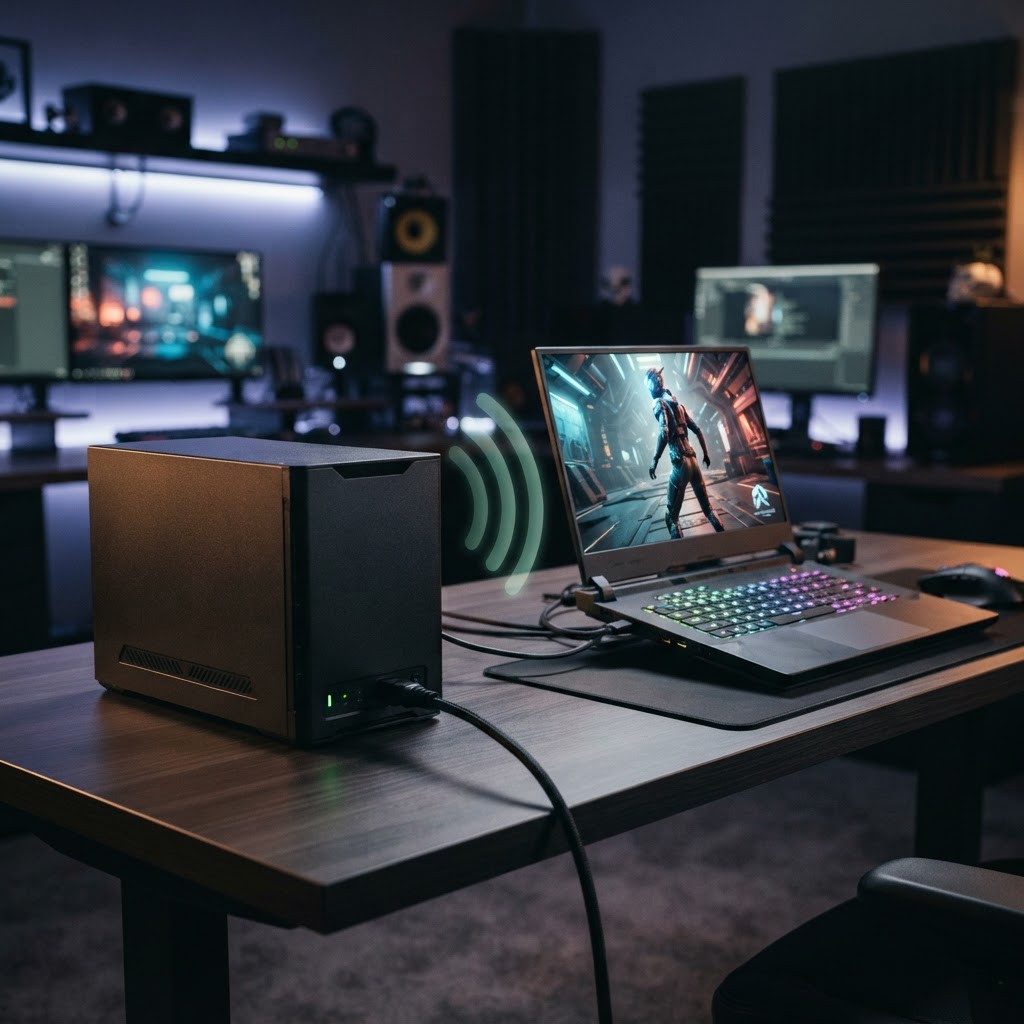
WiCi One: The First Wireless eGPU Streams an RTX 5090 Over Wi-Fi 7
The WiCi One is the first wireless external GPU — an enclosure that streams desktop-class graphics to your laptop, phone, or mini-PC over Wi-Fi 7 instead of a cable. Here's how it works, the performance WiCi is promising, the 11.5 Gbps catch nobody's talking about, and whether the $1,999 preorder is worth it.
Every external GPU ever made has shared one fatal flaw: the cable. You buy a sleek ultrabook, you buy a big desktop graphics card, and then you connect them with a hose. The WiCi One wants to cut that hose for good — it's the first wireless eGPU, an enclosure that streams full desktop-class graphics to your laptop, phone, or mini-PC over Wi-Fi 7.
Preorders start at $1,999, the retail tag lands at $2,599, and shipping is slated for Q4 2026. Here's what's actually inside the box, what WiCi is promising, and the bandwidth math that decides whether this is a revolution or a really expensive Wi-Fi access point.
The eGPU, Unplugged: How It Works
Traditional eGPU docks are dumb pass-through devices — a Thunderbolt 5 or OCuLink cable carrying PCIe traffic to a card sitting on your desk. The WiCi One takes a completely different approach: it's really a standalone mini-PC with its own processor, storage, and cooling system.
The magic is in the software stack:
- A virtual GPU driver — install it on your laptop, Mac, or Linux machine, and your operating system genuinely believes the graphics card is physically installed inside the computer
- Custom data compression — standard PCIe communication is chatty and would lag horribly over any wireless link, so WiCi compresses the traffic and runs an independent execution stack inside the box to dodge latency and constant status queries
- Compute sharing — because it lives on your network rather than a cable, multiple devices can share the same GPU at once, turning it into a shared local AI server for the whole house
That last point is bigger than gaming. More on it below.
Two Boxes, Two Very Different Bills
WiCi has outlined two configurations, and the gap between them is enormous:
| Feature | Base Configuration | High-End Configuration |
|---|---|---|
| Graphics Card | NVIDIA GeForce RTX 5060 Ti (16GB) | NVIDIA GeForce RTX 5090 (32GB) |
| Processor | Intel Core 3 100U | Intel Core Ultra 7 255H |
| Storage | 1TB NVMe Gen 4 SSD | 4TB PCIe 5.0 NVMe SSD |
| Wireless Stack | Wi-Fi 7 (4x4 MIMO, 320 MHz) | Wi-Fi 7 (4x4 MIMO, 320 MHz) |
The base model carries the $1,999 preorder / $2,599 retail pricing. The RTX 5090 variant's price will be announced closer to launch — start saving anyway.
The Performance WiCi Is Promising
According to WiCi's demos, the wireless link doesn't neuter the hardware:
- Cyberpunk 2077 at 4K Ultra with DLSS 4 runs at 80 FPS on the RTX 5060 Ti model — and 110 FPS on the RTX 5090 variant
- Black Myth: Wukong hits 60 FPS and 90 FPS respectively
- Both configs expose OpenAI-compatible API endpoints, so local LLM clients can offload inference straight to the box over your home network
That last bullet is the sleeper feature. A 32GB RTX 5090 sitting on your network as a shared AI accelerator — serving every laptop, desktop, and phone in the house — is arguably a more compelling story than the gaming one.
The Catch: 11.5 Gbps of Wireless Reality
Now the part the press release doesn't shout. Wi-Fi 7's theoretical ceiling is 46.1 Gbps, but the WiCi One's 4x4 radio tops out at 11.5 Gbps. Compare that to the wired competition:
| Connection | Realistic Bandwidth |
|---|---|
| Wi-Fi 7 (theoretical maximum) | 46.1 Gbps |
| WiCi One 4x4 Wi-Fi 7 radio | 11.5 Gbps |
| OCuLink | 64 Gbps |
| Thunderbolt 5 | Up to 120 Gbps |
The wireless link delivers roughly a fifth of OCuLink and under a tenth of Thunderbolt 5. WiCi bridges that gap the same way every remote-GPU product does: heavy compression, the internal CPU doing execution, and software optimizations tuned per workload. In controlled demos, that works. In your house — with walls, a microwave, three smart TVs, and a router from 2021 — the ceiling drops fast.
Analysts are right to be cautious: company demos are not your living room. The design is clever enough that the skepticism isn't "will it boot" — it's "will frame pacing hold up under real-world interference at 30 feet."
Should You Preorder?
The honest read:
- If you want a local AI server that every device in the house can share, the concept is genuinely compelling
- If you want a cable-free gaming rig for a thin laptop, the idea is thrilling — but nobody outside WiCi has verified frame times on a real network yet
- If you already own a wired eGPU, there's no reason to switch before independent reviews land
$1,999 early / $2,599 retail is premium but not absurd for what amounts to a mini-PC with a desktop GPU inside. The smarter play for most people: keep the money ready, wait for the first Q4 2026 hands-on reviews, then decide.
The Wrap-Up
The cable has been the eGPU's original sin since the category was invented, and WiCi is the first company to seriously attack it. Even if the WiCi One stumbles out of the gate, the blueprint — a GPU as a networked, shared, AI-capable appliance — is where this industry is going. The people watching this space early are the ones who'll understand it first when it works.
What would you actually do with a graphics card that floats around your house over Wi-Fi — game on the couch, or run a home AI server? Tell me in the comments, and if you're as curious as I am, hit the notify button so you catch the follow-up when the real-world benchmarks land.
Derrk Samuel
Web3, crypto, and Linux PC insights — practical guides, security tips, mining setups, blockchain tools, and decentralized tech strategies for techs.
Related Articles


Discussion
Leave a comment
No comments yet. Be the first to start the discussion!